- You are here:
- Home
- Skills@Library
- Students
- Referencing
Referencing
Referencing is the acknowledgment of the sources you used when producing your piece of work. The resources on this page will help you to cite and reference your academic work accurately.
Each school in the University requires students to use a specific style of referencing. Check the referencing style used in your school before you begin.
References and citations explained
You need to give the person reading your assignment enough information to find the sources you have consulted. This is done by including citations in your work and providing a list of references.
Citations
Whenever you use someone else's ideas, either by putting them into your own words (paraphrasing) or by quoting directly, you must show this within the body of your work. This is known as a citation. The format will vary depending on the referencing style you use.
References
At the end of your assignment you will need to provide a list of references - full details of the sources you used when writing your assignment. Your references may take the form of either a reference list or a bibliography.
Your faculty team librarian can offer further help and advice.
Harvard style
Sometimes referred to as the author-date style, this is one of the most commonly used styles of referencing. The official University of Leeds guidance is based on the British Standard for referencing.
- Referencing different types of material (examples)
- Inserting citations (references within your text)
- Common issues (multiple authors, no author, no date etc)
- Reference lists and bibliographies
- Using and citing quotations
- Harvard referencing tutorial
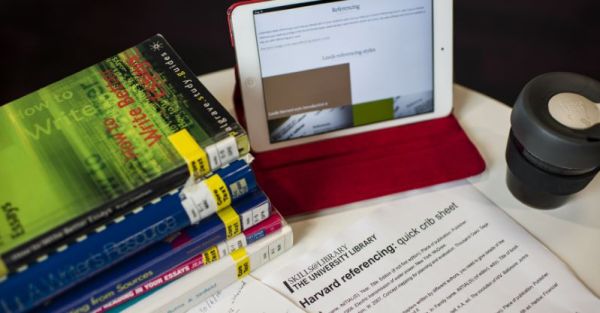
- Harvard: quick crib sheet (PDF)
- Book onto a referencing workshop.
Numeric style
Also known as the Numbered style. The official University of Leeds guidance is based on the British Standard for referencing.
- Referencing different types of material (examples)
- Inserting citations (references within your text)
- Common issues (multiple authors, no author, no date etc)
- Reference lists and bibliographies
- Using and citing quotations
- Numeric referencing tutorial
- Numeric: quick crib sheet (PDF)
- Book onto a referencing workshop.
MHRA style
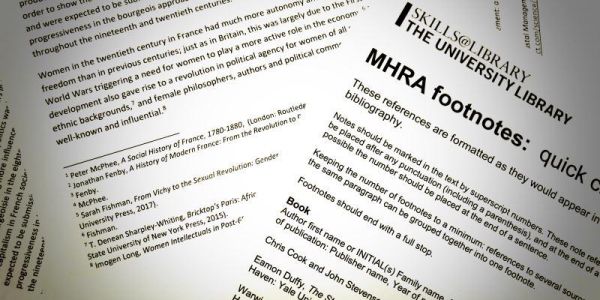
Also known as the Footnotes style. It is produced by the Modern Humanities Research Association. The Library "basic guide" document was co-written with the School of History: guidance from other schools may differ.
- MHRA basic guide
Co-written by the Library and the School of History (guidance from other schools may differ) - MHRA style guide
Full guide from the MHRA - MHRA referencing tutorial.
APA, IEEE, OSCOLA, Royal Society of Chemistry and Vancouver styles
APA
This style is usually used within Psychology and related disciplines. It is produced by the American Psychological Association.
IEEE
The IEEE (Institute of Electrical and Electronics Engineers) style is used by the School of Electronic and Electrical Engineering.
OSCOLA
This style is used by Law Qualifying Programmes in the School of Law. It is produced by the Oxford Law Faculty at the University of Oxford.
Royal Society of Chemistry
The University of Leeds uses a slightly modified version of the Royal Society of Chemistry referencing style.
Vancouver
This style is used in the School of Medicine. The guidelines for this style are set by the International Committee of Medical Journal Editors.
Test yourself: referencing activities
Knowing when and where to reference is key to avoiding plagiarism.
- Referencing tutorial
- When to reference (activity)
Identify in which circumstances you need to include a reference - Where to reference (activity)
Identify at which points in a text you need to include a reference - Skills@Library plagiarism page
Further advice, information and activities on what plagiarism is and how to avoid it.
EndNote and other referencing tools
Referencing software (such as EndNote) not only helps you to store and manage your references, it also works with word-processing applications (like Microsoft Word) to automatically insert citations and create your bibliography or reference list for you.
- Skills@Library EndNote support
Help, guides, online tutorials and workshops - Other referencing tools
Information about alternatives to EndNote.