

Sir Gawain and the Green Knight – a Queer Medieval Love Story?


![CC.5705 [1]](https://explore.library.leeds.ac.uk/multimedia/78736/655451_001.thumb.jpg)
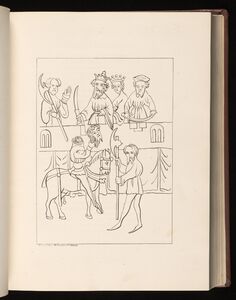
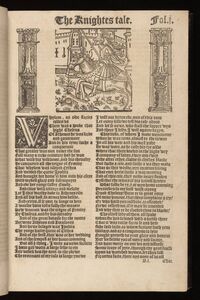
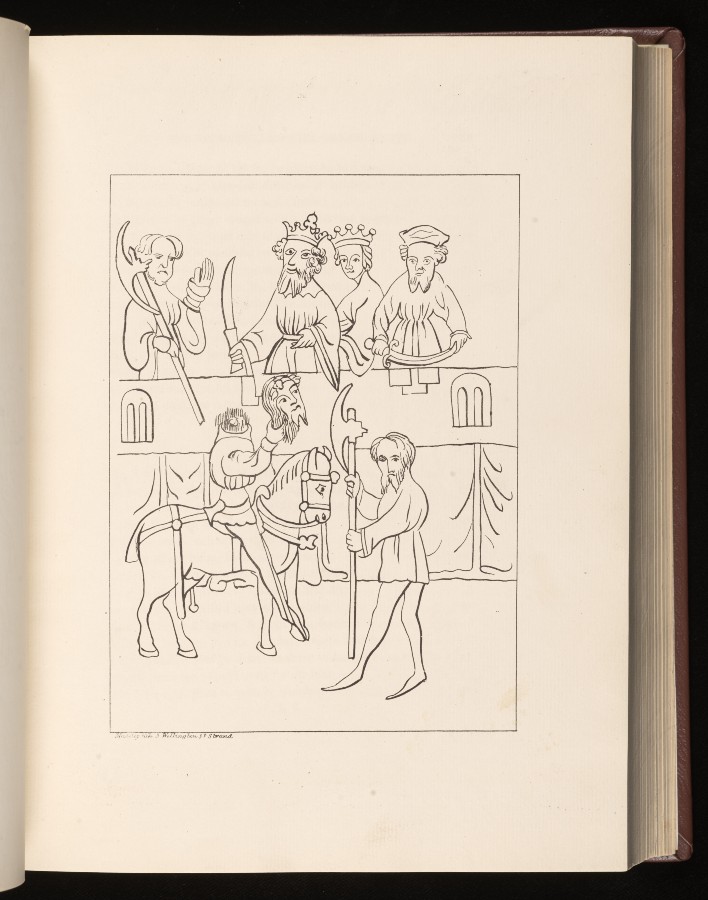
A key text of the medieval era, which is both an epic poem and chivalric romance, is the story of Sir Gawain and the Green Knight. Written by an anonymous author in the 14th century, it is based in the context of the Arthurian legend. The tale begins with the Green Knight entering court and challenging any man to strike him. Sir Gawain accepts, cutting off the knight’s head, but he miraculously survives. The Green Knight promises to return this in a year and a day at the proposed location of the Green Chapel. Gawain then spends a year trying to find this Chapel, arriving at a castle, where he is greeted by a couple named Lord and Lady Bertilak. They play numerous games with Gawain and Lady Bertilak then attempts to seduce him, but he only accepts to a kiss. Later, Gawain confronts the Green Knight at the chapel, who strikes him, but he just receives a minor cut and survives. The Green Knight then unveils himself to be his host Lord Bertilak and Gawain is rewarded for his virtue.
The story is ultimately about dishonesty, bravery and chivalry while also having themes of temptation and desire. At the beginning, the narrator describes the Green Knight in great detail, praising him as a marvellous giant and complimenting his physique and attractiveness. Within the games between Gawain and the couple, Gawain promises to give Bertilak whatever he has received during his stay, in exchange for whatever Bertilak wins on his hunt. When Gawain kisses Lord Bertilak’s wife, at the end of each day, Gawain must ‘give’ these kisses to the Lord. This is with the implication that if he was seduced further, he would have had to follow the same rule.
Cultural Collections has various copies of the story of Sir Gawain and the Green Knight, including in a nineteenth century collection of romance poems (Large English C-7 SIR) and a twentieth century art book depicting the story through lithograph prints (BC Case 40/SIR).
We may also look at this work in the broader context of chivalry, which has been argued to have homosocial undertones. Chivalric culture was very accepting of men showing affection to each other, but no medieval romance would have been able to explicitly depict gay desire in this context. As a knight, Gawain was set to embody the moral codes of masculine identity. In this context, sexuality often revolved around the position of men, in being active or passive. The temptation of Lady Bartelik puts Gawain in the medieval social context of a woman who is being courted, which could be seen as subverting his gender [10]. Here, the act of ‘queering’ examines convention outside of social order. Around the same time period, there are other stories that hint at Queerness, whereby women seem to become objects of which gay desire is facilitated through [11].
Cultural Collections contain many other works of poetry from the medieval era, such as Confessio Amantis (BC H de W GOW), a poem written by John Gowler (1330-1408), consisting of a long confession by an ageing lover. It encompasses cross-dressing and gender transformation in stories within it, such as the story of Iphis and Ianthe, which features a female character who eventually transitions. Other stories have gendered themes, such as Orlando Furioso (Strong Room for. 4to 1584/ARI), which was written just at the end of the Middle Ages. In this, the character Fiordispina takes the character Bradamante for a man and immediately falls in love with her.
[10] David Boyd, ‘Sodomy, Misogyny, and Displacement: Occluding Queer Desire in "Sir Gawain and the Green Knight’, Arthuriana, 8 (1998), 77-113 (p.80).
[11] Boyd, p.80.
© Copyright University of Leeds