

Queer Desire and Identity in the Works of Chaucer


![CC.5705 [1]](https://explore.library.leeds.ac.uk/multimedia/78736/655451_001.thumb.jpg)
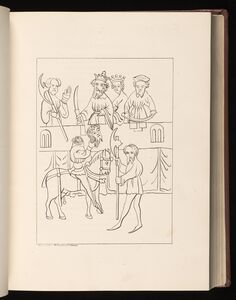
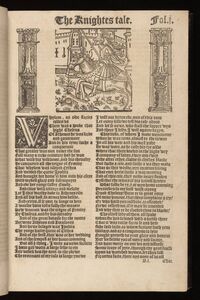

Geoffrey Chaucer is often considered the father of English poetry. He is one of the first to write in Middle English and best known for his long poem, The Canterbury Tales. The work consists of 29 characters on pilgrimage to Canterbury, all with their own stories and identities. Cultural Colletions has numerous copies of the work, the oldest being from 1526 (BC Safe/CHA) and 1561 (BC H de W/CHA).
One character in particular, the Pardoner, has been considered through a Queer lens. It is proposed that he is of ambiguous gender, being described by the narrator as ‘a gelding or a mare’. A gelding is a castrated horse, and a mare is a female horse. Along with descriptions of the Pardoner’s voice and beardless chin, this would have meant the pardoner would have been interpretated as a eunuch or an effeminate man [12]. In Chaucer’s time, these descriptions were used to describe what we may, in our modern terms label, as intersex or gay.
The Knight’s Tale also hints at alternative desire, particularly in the homoromantic undertones between the characters Arcite and Palamon. There is a rivalry between them, in a pursuit of a woman named Emily. It is possible that Chaucer implies they are descended from The Sacred Band of Thebes, a Greek military group from around 300 BCE. The group consisted of 150 gay male couples, with their emblem being a lion, which he used heavily to describe the characters, as a symbol of lust and jealousy. This tale also references the phenomena of wedded brotherhood, which was a common theme in chivalric romance and could perhaps be seen as a form of symbolic marriage. Many contemporary works of poetry reveal ideas of ‘romantic friendship’, such as the 13th century German tale Parzival (German C-27/Wol).
[12] Jeffrey Rayner Myers, ‘Chaucer's Pardoner as Female Eunuch’, Studia Neophilologica, 72 (2000), 54-62 (p.54).
© Copyright University of Leeds